HOP – High-Order analysis of random Processes
A
A tool to dissect directed and causal multivariate dynamic interactions in networks of
oscillatory processes
Granger causality (GC), a popular statistical method for the
inference of directional influences between time series measured from a
complex network, is sensitive to high-order (non-pairwise) interactions
which fundamentally shape the collective network dynamics. This work
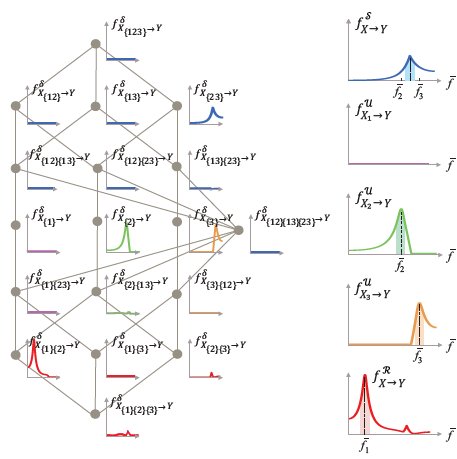
introduces Partial Decomposition of Granger Causality (PDGC), a tool to
elicit redundant and synergistic causal interactions among the
subsystems of physiological networks. PDGC is formulated using the
framework of partial information decomposition (PID) to dissect the
multivariate GC from a set of driver random processes to a target
process into unique effects carried exclusively by each driver,
redundant effects carried identically by more drivers, and synergistic
effects carried jointly by some drivers but not by any of them
individually. Computation is based on multivariate state-space models
expanded in the frequency domain to assess PDGC both in specific bands
and in the time domain after whole-band integration. The method is
presented in [Faes et al., 2026].
PDGC is a part of the HOP Matlab toolbox "High Order analysis of random Processes", which implements also the measures of Partial Information Rate Decomposition (PIRD, [Faes et al., 2025]). The toolbox is described in the supporting document reported here below.
HOP Matlab Toolbox documentation: HOP_doc.pdf
DOWNLOAD: Zip file with all scripts and functions: HOP.zip
The code is provided free of charge. It is neither exhaustively tested
nor particularly well documented. The authors accept no liability for
its use. Use, modification and redistribution of the code is allowed in
any way users see fit. Authors ask only that authorship is acknowledged
and ref. [1] is cited upon utilization of the code in integral or
partial form.
DISCLAIMER OF
WARRANTIES AND LIMITATION OF LIABILITY The code is supplied as is and
all use is at your own risk. The authors disclaim all warranties of any
kind, either express or implied, as to the softwares, including, but
not limited to, implied warranties of fitness for a particular purpose,
merchantability or non - infringement of proprietary rights. Neither
this agreement nor any documentation furnished under it is intended to
express or imply any warranty that the operation of the software will
be error - free. Under no circumstances shall the authors of the
softwares provided here be liable to any user for direct, indirect,
incidental, consequential, special, or exemplary damages, arising from
the software, or user' s use or misuse of the softwares. Such
limitation of liability shall apply whether the damages arise from the
use or misuse of the data provided or errors of the software.
References:
[Faes et al., 2025] - L Faes, G Mijatovic, R Pernice, D Marinazzo, S Stramaglia, Y Antonacci, 'Dissecting Spectral Granger Causality through Partial Information Decomposition', preprint: arXiv paper
[Faes et al., 2026] - L Faes, L Sparacino, G Mijatovic, Y Antonacci, L Ricci, D Marinazzo, S Stramaglia, 'Partial Information Rate Decomposition', Physical review Letters 2025; 135:187401. DOI: 10.1103/nrwj-n8lj